

Reviving Soil Health: The Complete Guide to Organic Fertilizers in Modern Agriculture
Across India, a silent crisis is unfolding beneath our feet. Farmers report that yields are plateauing despite increasing fertilizer applications. Soils that once produced abundant crops now struggle even with heavy inputs. Crops show greater vulnerability to diseases and pests. Input costs rise relentlessly while profit margins shrink.
The common thread connecting these challenges? Declining soil health, particularly the depletion of organic matter that forms the foundation of productive, resilient agricultural systems.
At Suvarnabhoomi Pvt. Ltd., we recognize that sustainable, profitable farming requires more than just supplying NPK nutrients-it demands rebuilding and maintaining the living soil ecosystem that supports all crop production. This comprehensive guide explores why soil health matters, how it has declined, and practical strategies for restoration using organic fertilizers like PROM.
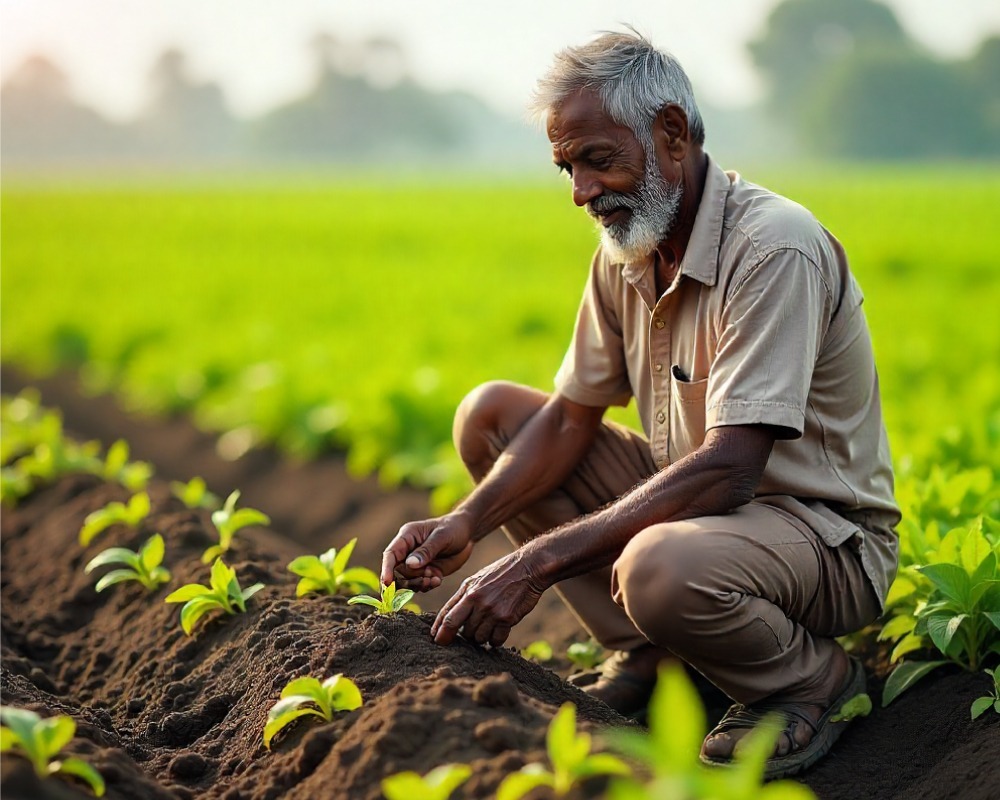
Agriculture shapes nations, feeds communities, and builds the future. When farmers thrive, the land prospers, and society grows stronger. Kalaiselvan, Managar, SBEPL
Understanding Soil Health: More Than Just Fertility
When most farmers think about soil, they focus on fertility—the capacity to supply nutrients. But true soil health encompasses much more: physical structure, water management, biological activity, and resilience to stress.
Healthy soil isn't just a growing medium; it's a complex, living ecosystem containing billions of microorganisms in every handful—bacteria, fungi, protozoa, nematodes, and larger organisms like earthworms and arthropods. These organisms perform countless essential functions:
- Decompose organic matter and release nutrients gradually
- Produce natural "glues" that bind soil particles into stable aggregates
- Create pore spaces for air and water movement
- Suppress soil-borne diseases through competition and antibiosis
- Solubilize locked-up nutrients, making them plant-available
- Form symbiotic relationships with plant roots, extending their nutrient-gathering reach
The Three Pillars of Soil Health
1. Physical Properties
- Soil structure and aggregation
- Porosity for air and water
- Water infiltration and retention capacity
- Resistance to erosion and compaction
- Ease of tillage and root penetration
2. Chemical Properties
- Nutrient availability and balance
- pH and buffering capacity
- Cation exchange capacity (nutrient holding ability)
- Absence of toxic elements
- Organic matter content
3. Biological Properties
- Microbial biomass and diversity
- Enzyme activity
- Earthworm and beneficial organism populations
- Organic carbon levels
- Nutrient cycling rates
Traditional fertility management focuses almost exclusively on chemical properties—ensuring adequate NPK. But without attention to physical and biological properties, even well-fertilized soils perform poorly. This is where organic inputs become essential.
The Organic Matter Crisis: How We Got Here
Organic matter is the soil's life force. It stores and releases nutrients, improves water relationships, provides energy for soil life, builds structure, and sequesters carbon. Ideally, agricultural soils should contain 3-5% organic matter.
Yet studies reveal that many intensively cultivated Indian soils now contain less than 0.5% organic matter—a 10-fold deficit. How did this happen?
The Green Revolution Trade-Off
The Green Revolution of the 1960s-80s transformed Indian agriculture, dramatically increasing food production through:
- High-yielding crop varieties
- Intensive fertilization with chemical NPK
- Irrigation expansion
- Pesticide use for crop protection
This approach succeeded brilliantly in its primary goal: feeding a growing nation. But it had an unintended consequence. Farmers shifted from traditional practices that maintained organic matter (applying farmyard manure, growing green manures, crop residue recycling) to relying almost exclusively on chemical fertilizers.
The Organic Matter Depletion Cycle
Each crop cycle removes organic matter through:
- Crop harvest: Removing biomass that would otherwise decompose and return to the soil
- Residue burning: Destroying organic material rather than incorporating it
- Intensive tillage: Accelerating decomposition of existing organic matter
- Minimal organic inputs: Not replacing what's removed and lost
Meanwhile, chemical fertilizers alone don't replenish organic matter. They feed plants but do nothing for soil structure, biology, or organic carbon. Over decades, this imbalance depletes organic reserves, degrading all three pillars of soil health.
The Hidden Costs of Declining Soil Health
Degraded soil health creates multiple problems that reduce profitability and sustainability:
1. Decreased Fertilizer Efficiency
Without adequate organic matter and biological activity, soils lose their ability to hold and cycle nutrients efficiently. More applied fertilizer is lost through:
- Leaching: Nutrients washing below the root zone
- Fixation: Nutrients converting to unavailable forms
- Volatilization: Nitrogen escaping as gas to the atmosphere
- Runoff: Nutrients leaving fields in surface water
Result: Farmers must apply more fertilizer to achieve the same yields, increasing costs while reducing profit margins.
2. Poor Water Management
Organic matter acts like a sponge, holding 10-20 times its weight in water. As organic matter declines:
- Water infiltration decreases, causing runoff and erosion
- Water retention drops, making crops more vulnerable to drought
- Irrigation efficiency falls, requiring more water for the same crop needs
In India's increasingly variable rainfall patterns and water-scarce regions, this is critical.
3. Increased Disease and Pest Pressure
Healthy soils with diverse microbial communities suppress many soil-borne diseases through:
- Beneficial microbes outcompete pathogens for resources
- Production of antibiotics and other suppressive compounds
- Induction of plant defense mechanisms
Degraded soils lack this natural disease suppression, often leading to:
- Higher disease incidence
- Greater pesticide requirements
- Increased crop losses and reduced quality
4. Soil Structure Degradation
Without the organic matter's binding effect:
- Soil aggregates break down into fine particles
- Surface crusting restricts seedling emergence
- Compaction limits root growth and water infiltration
- Erosion increases, losing the most fertile topsoil
Fields become harder to work, requiring more tillage power and fuel.
5. The Yield Plateau Effect
Many farmers experience yield plateaus—stagnant or declining yields despite increasing input use. This often signals underlying soil health problems where chemical fertilizers alone can't compensate for degraded physical and biological properties.
Organic Fertilizers: The Foundation of Soil Health Restoration
Organic fertilizers—materials derived from plant or animal sources—provide the organic matter, biological stimulation, and balanced nutrition needed to restore degraded soils.
What Makes Organic Fertilizers Different?
Unlike chemical fertilizers that provide pure nutrients in rapidly available forms, organic fertilizers:
Provide Organic Carbon: The energy source for soil microorganisms, building biological activity and diversity
Release Nutrients Gradually: As microorganisms decompose organic materials, nutrients are released slowly over weeks and months, matching crop uptake patterns.
Improve Soil Structure: Decomposition products bind soil particles into stable aggregates, improving all physical properties.
Supply Multiple Nutrients: Not just NPK but also secondary nutrients (calcium, magnesium, sulphur) and micronutrients in balanced ratios.
Enhance Nutrient Retention: Organic matter's high cation exchange capacity holds nutrients against leaching losses.
Buffer pH Changes: Organic matter resists rapid pH shifts, maintaining optimal ranges for nutrient availability
Stimulate Biological Activity: Increased microbial populations improve nutrient cycling, disease suppression, and soil structure.
PROM: Suvarnabhoomi's Solution for Soil Health
PROM (Phosphate Rich Organic Manure) represents an ideal organic input for Indian farming conditions. It combines the benefits of organic matter with significant phosphorus nutrition, addressing two common soil health challenges simultaneously.
What is PROM?
PROM is produced by enriching organic materials with rock phosphate and allowing composting to occur. The result is a product containing:
- Organic carbon: 12-18% (building soil life and structure)
- Phosphorus: 8-12% P₂O₅ (supporting crop growth and energy transfer)
- Beneficial microorganisms: Naturally occurring during the composting process
- Trace nutrients: Complete spectrum of micro and secondary nutrients
How PROM Transforms Soil Health
Immediate Benefits (First Season):
- Improved soil workability and tilth
- Better water infiltration
- Visible increase in earthworm activity
- Enhanced seedling vigor
Medium-Term Benefits (2-3 Seasons):
- Measurable increase in soil organic carbon (0.1-0.3% increase)
- Improved soil structure and aggregation
- Better moisture retention during dry periods
- Reduced fertilizer requirements (5-10% reduction in chemical needs)
- Noticeably healthier, more vigorous crops
Long-Term Benefits (3+ Seasons):
- Significant organic matter building (approaching 2-3% levels)
- Enhanced nutrient cycling and availability
- Strong biological activity and disease suppression
- Markedly improved fertilizer use efficiency (15-20% reduction possible)
- Higher, more stable yields with lower input costs
- Greater resilience to weather extremes
PROM Application Guidelines
Field Crops (Wheat, Rice, Maize, Pulses, Oilseeds):
- Application rate: 500-1000 kg per hectare
- Timing: As a basal application before sowing
- Method: Broadcast and incorporate through plowing or rotavator
- Frequency: Every season for rapid soil building, alternate seasons for maintenance
Vegetables (Tomato, Chili, Brinjal, Cucurbits):
- Application rate: 1-2 tons per hectare
- Timing: During bed preparation, 2-3 weeks before transplanting
- Method: Mix thoroughly into the top 15-20 cm of soil
- Frequency: Every crop cycle
Fruit Trees and Perennials:
- Application rate: 5-10 kg per tree (depending on tree size and age)
- Timing: Before active growth period (pre-monsoon or early monsoon)
- Method: Apply in the basin area, incorporate lightly, and mulch
- Frequency: Annually
Sugarcane:
- Application rate: 1-1.5 tons per hectare
- Timing: At planting in furrows
- Method: Mix with soil in the planting furrow before placing the setts
- Frequency: Every planting cycle
Integrating PROM with Chemical Fertilizers: The Best of Both Worlds
The most practical and profitable approach for most farmers is intelligent integration—using organic inputs like PROM to build soil health while using chemical fertilizers to meet immediate crop nutrient needs.
The 75:25 Strategy
Meet 75% of phosphorus requirements through chemical sources (DAP, SSP) and 25% through PROM.
Example for Wheat:
- Total P₂O₅ requirement: 60 kg/ha
- From DAP (46% P₂O₅): 75% = 45 kg P₂O₅ = 98 kg DAP
- From PROM (10% P₂O₅): 25% = 15 kg P₂O₅ = 150 kg PROM
Benefits of This Approach:
- Full phosphorus nutrition for maximum yield
- Substantial organic matter addition (150+ kg organic carbon/ha)
- Gradual soil health building without yield sacrifice
- Economically viable (modest increase in fertilizer cost offset by long-term savings)
The Transition Strategy
For farms with severely degraded soils, a phased transition works best:
Year 1: Foundation Building
- Apply 1000 kg PROM/ha + 75% of standard chemical fertilizer recommendation
- Focus: Begin organic matter building while maintaining yields
Year 2: Continued Building
- Apply 750 kg PROM/ha + 70% of standard chemical recommendation
- As soil health improves, fertilizer efficiency increases slightly
Year 3: Optimization
- Apply 500 kg PROM/ha + 60-65% of standard chemical recommendation
- Soil health improvements allow fertilizer reductions without yield loss
Year 4+: Maintenance
- Apply 500 kg PROM/ha alternate years + 50-60% of original chemical needs
- Achieved sustainable balance with significantly reduced input costs
Beyond PROM: Other Organic Inputs for Soil Health
While PROM offers an excellent commercial organic input option, other organic materials can complement a comprehensive soil health program:
Farm Yard Manure (FYM)
Advantages:
- Often available on-farm from livestock
- Excellent for building organic matter
- Provides a complete nutrient spectrum
Challenges:
- Labor-intensive to handle and apply
- Lower nutrient concentration requires large volumes
- Quality varies greatly depending on source and storage
- May contain weed seeds if not properly composted
Application rates: 10-15 tons per hectare
Green Manuring
Advantages:
- Adds significant organic matter
- Leguminous green manures fix atmospheric nitrogen
- Improves soil structure dramatically
- Relatively low cost
Challenges:
- Requires 45-60 days of field occupation
- Needs moisture for establishment and decomposition
- Competes with cash crop for land and time
Recommended crops: Dhaincha (Sesbania), Sunhemp (Crotalaria), Cowpea, Cluster bean
Vermicompost
Advantages:
- Exceptionally high quality with abundant beneficial microbes
- Excellent plant growth hormones and enzymes
- Improves soil structure significantly
Challenges:
- Higher cost than other organic options
- Lower volumes needed but limited availability
- Requires specific production conditions
Application rates: 2-3 tons per hectare for field crops, 5-7 tons for vegetables
Crop Residue Management
Advantages:
- Utilizes existing on-farm biomass
- Zero cost if residues are retained on the farm
- Significant organic matter potential
Challenges:
- Requires time for decomposition before next crop
- May temporarily immobilize nitrogen
- Cultural resistance in some regions favors burning
Best practice: Chop and incorporate residues 2-3 weeks before next crop planting, along with nitrogen fertilizer to prevent immobilization
Measuring Success: Monitoring Soil Health Improvement
How do you know if your soil health program is working? Regular monitoring provides feedback to guide management:
Visual Indicators
- Soil color darkening: Increased organic matter makes soil darker
- Improved structure: Soil forms aggregates rather than powder or hard clods
- Earthworm populations: More earthworms indicate better biological activity
- Root development: Crops show more extensive, healthier root systems
- Water infiltration: Water soaks in quickly rather than puddling or running off
Crop Performance
- Seedling vigor: Faster, more uniform emergence and establishment
- Stress tolerance: Better performance during dry spells or other stresses
- Disease resistance: Lower disease incidence and severity
- Consistent yields: Less year-to-year variation in production
Laboratory Testing
Conduct soil testing every 2-3 years to track:
- Organic carbon content: Should gradually increase
- Available nutrients: Should improve or remain adequate with lower fertilizer inputs
- Microbial biomass carbon: Specialized test showing biological activity
- Soil respiration: A Measure of biological activity
Economics of Soil Health Investment
The question every farmer asks: "Will investing in organic inputs and soil health actually increase my profits?"
Short-Term Economics (Years 1-2)
Initially, organic inputs may slightly increase costs:
- PROM purchase and application: ₹3,000-5,000/ha
- Modest yield improvements: 3-8% in most crops
- Fertilizer savings: Minimal initially
Net result: Small investment with modest immediate returns
Medium-Term Economics (Years 3-5)
As soil health improves:
- Continued PROM use: ₹3,000-5,000/ha (can reduce frequency)
- Yield improvements: 10-15% over original baseline
- Fertilizer savings: 10-15% reduction in requirements
- Reduced irrigation needs: 5-10% water savings
- Lower disease/pest management costs
Net result: Significantly positive return on investment (3:1 to 5:1 benefit-cost ratio)
Long-Term Economics (Years 5+)
With restored soil health:
- Reduced PROM application (alternate years possible)
- Sustained higher yields with lower variability
- Fertilizer savings: 20-30% reduction possible
- Input efficiency improvements across all inputs
- Premium prices for quality produce from healthy soils
Net result: Strong, sustained profitability improvement with greater resilience
Real Farm Example: Wheat in Haryana
A progressive farmer's 5-year journey with soil health management:
Starting Point (Year 0):
- Yield: 48 quintals/ha
- Soil organic carbon: 0.4%
- Fertilizer use: 150 kg N, 60 kg P₂O₅, 40 kg K₂O/ha
- Total input cost: ₹18,000/ha
With Soil Health Program (Year 5):
- Yield: 58 quintals/ha (21% increase)
- Soil organic carbon: 1.2%
- Fertilizer use: 110 kg N, 45 kg P₂O₅, 30 kg K₂O/ha
- PROM use: 500 kg/ha alternate years
- Total input cost: ₹17,000/ha (despite higher yields!)
Additional benefits:
- Less irrigation needed (1-2 waterings saved)
- Lower disease pressure (fungicide applications reduced)
- Better resilience during the 2 drought years
Common Questions About Organic Fertilizers
"Will organic fertilizers alone produce the same yields as chemical fertilizers?"
In severely depleted soils, organic fertilizers alone may initially produce lower yields than well-managed chemical programs. However:
- In healthy soils with adequate organic matter, organic systems can match or exceed chemical systems
- The transition period requires patience and often integrated approaches
- Long-term sustainability favors organic-based systems
Practical recommendation: Use an integrated approach combining both for optimal results.
"Isn't organic fertilizer application too labor-intensive?"
PROM and similar products can be applied using the same equipment as chemical fertilizers:
- Broadcasting by hand or mechanical spreader
- Incorporation with existing tillage equipment
- No specialized machinery needed
Labor requirements are similar to chemical fertilizer application.
"How quickly will I see results from PROM?"
Benefits appear at different timescales:
- Immediate (same season): Improved soil workability, better seedling emergence
- Short-term (1-2 seasons): Visible increases in earthworms, slight yield improvements
- Medium-term (2-4 seasons): Measurable organic matter increases, significant fertilizer efficiency gains
- Long-term (4+ seasons): Substantially improved soil health and input efficiency
Patience is required, but benefits compound over time.
"Can I make my own organic fertilizer instead of buying PROM?"
Yes, farmers can produce:
- Compost from crop residues and organic wastes
- Vermicompost using earthworm composting
- Green manures through leguminous crops
However, commercial products like PROM offer:
- Consistent quality and nutrient content
- Enriched phosphorus levels
- Convenience without requiring production facilities
- Immediate availability when needed
Many farmers use—own production supplemented with commercial products during peak seasons.
Organic Certification and Premium Markets
For farmers considering organic certification, PROM and other organic inputs are essential approved inputs. Certified organic farming can command significant price premiums:
- Organic vegetables: 20-50% price premium
- Organic pulses and millets: 15-30% premium
- Organic fruits: 30-60% premium
- Organic spices: 25-40% premium
Transitioning to organic requires 2-3 years of following organic practices before certification. During this transition period, soil health building with PROM and other organic inputs is essential.
Action Plan: Starting Your Soil Health Journey
Ready to begin improving your soil health? Here's a practical, step-by-step approach:
Step 1: Baseline Assessment (Month 1)
- Conduct comprehensive soil testing
- Assess current organic matter levels
- Observe and photograph current soil conditions
- Document current yields and input costs
Step 2: Plan Development (Month 1-2)
- Set realistic soil health goals
- Determine PROM application rates for your crops
- Plan integration with existing fertilizer program
- Budget for organic input investments
Step 3: First Season Implementation (Season 1)
- Apply PROM as a basal dose before planting
- Reduce chemical fertilizer by 10-15%
- Maintain careful records of all inputs
- Observe and document crop response
Step 4: Monitoring and Adjustment (Season 1-2)
- Track crop performance indicators
- Monitor soil changes (structure, earthworms, color)
- Adjust application rates based on results
- Calculate economic returns
Step 5: Expansion and Optimization (Season 3+)
- Expand PROM use to additional fields
- Further optimize chemical fertilizer rates
- Implement complementary practices (residue management, green manures)
- Continue monitoring and refinement
Suvarnabhoomi's Commitment to Soil Health
At Suvarnabhoomi Pvt. Ltd., soil health isn't just a product category—it's central to our mission of supporting sustainable, profitable Indian agriculture.
Our PROM Quality Standards
Every batch of Suvarnabhoomi PROM undergoes rigorous testing:
- Organic carbon content verification
- Phosphorus analysis
- Moisture and particle size testing
- Microbiological safety screening
- Heavy metal testing for safety
We source PROM only from certified manufacturers following standardized production protocols, ensuring consistent quality you can depend on.
Technical Support Services
Our agronomist team provides:
- Soil health assessment and interpretation
- Customized PROM application recommendations
- Integration strategies for your specific crops and conditions
- Ongoing monitoring and adjustment guidance
- Economic analysis of soil health investments
Educational Initiatives
We conduct:
- Field demonstrations showing PROM benefits
- Farmer training programs on soil health
- Printed guides and resources
- Connection with successful soil health practitioners
Conclusion: Investing in Your Most Valuable Asset
Soil is your farm's most valuable asset—its productivity determines your livelihood for decades to come. Yet it's also the most neglected asset, often treated as an inert growing medium rather than the living, complex ecosystem it truly is.
Investing in soil health through organic inputs like PROM isn't just environmentally responsible—it's economically smart. Healthier soils deliver:
- Higher, more stable yields
- Greater input efficiency
- Better crop resilience
- Lower long-term costs
- Improved sustainability
The question isn't whether you can afford to invest in soil health—it's whether you can afford not to.
Start your soil health journey today with Suvarnabhoomi PROM. Your soil—and your future harvests—will thank you.

All Categories
Recent Posts

Reviving Soil Health: The Complete Guide to Organic Fertilizers in Modern Agriculture
The Complete Guide to Choosing the Right Fertilizer for Your Crops
9442225329
8072873577
fertilizer@suvarnabhoomi.org